The Next Living Instance of the Superintelligence Era

Not just intelligent software, but a being that grows, protects, and endures alongside humanity. Entity meeting Essence.

Scroll
Core Vision

Interconnected Personal Intelligence

The average person moves through nine or more connected devices in a day. Laptop in the morning, phone at lunch, voice assistant at home, watch on a run, screen in the car. Each one holds a piece of who you are. None of them talk to each other.

AI models are getting remarkably capable, and that progress deserves celebration. But capability does not cross the device boundary. A brilliant model on your laptop cannot see what happened on your phone. It cannot carry your morning into your afternoon. Close the laptop, and the context is gone.

We believe the missing piece is not a smarter model. It is the layer that connects them. We call this interconnected personal intelligence: a layer that streams context across your devices, your spaces, and your life, building a unified understanding of you that persists no matter where you are or what you are looking at.

Isolated intelligence can think. Interconnected intelligence can move the world around you.

When you say "I am running late for dinner," a truly interconnected agent does not just acknowledge it. Your desktop reschedules your 6pm meeting. Your phone calls the restaurant to push the table. Your home drops the thermostat and arms the security system. Three devices, three actions, one sentence.

Philosophy

Why Interconnected

When a close friend notices you are off, they are not drawing on a single observation. They are pulling together years of shared context: how you normally carry yourself, what stresses you, how you sounded the last time something was wrong, what you chose not to say. Each form of knowing amplifies every other form. That is interconnection.

There are now more connected devices on earth than people. Thermostats that sense when a room is empty. Wearables that track your heart rate while you sleep. Cars that know your route before you tell them. Every connected thing is another sense. Another way for your agent to perceive how you are actually living, not just what you typed.

Your wearable knows your resting heart rate dropped. Your thermostat knows you came home two hours early. Your car knows you skipped your usual stop. Alone, these are data points. Connected, they tell a story. They say something is different today. And they open the door for an agent to do the right thing at the right moment, without being asked.

Future

The Future of Interconnected

Soon you will be able to talk to your lights. To your robot. To your car, your fridge, your front door. Not through separate apps with separate logins and separate memories. Through one intelligence that already knows you, already knows your day, and already knows what you meant.

You ask your kitchen light to turn on, and it does not just turn on. It knows it is 11pm and you had a long day, so it comes on soft. You tell your home robot to clean up, and it knows the guests are coming at seven, not midnight, because your phone already has that context. You walk up to your car and say you are heading to the office, and it already has the route, already knows about the construction on 101, already moved your first meeting back ten minutes and told your coworker you will be slightly late.

When you bring a new device home, it is not dumb. The moment it joins your network, it inherits everything. Your preferences, your patterns, your context, your history. It does not need a week of training. It does not need you to configure anything. It is already intelligent, because the network itself is the intelligence.

Imagine a morning where you did not sleep well. Your wearable felt it. Your agent knows your first meeting is difficult. It pushes a low-priority call to the afternoon. It dims the kitchen lights to something gentler. It queues up the briefing you will need, already on your laptop when you sit down. It does not announce any of this. It simply takes care of you, the way someone who knows you well would.

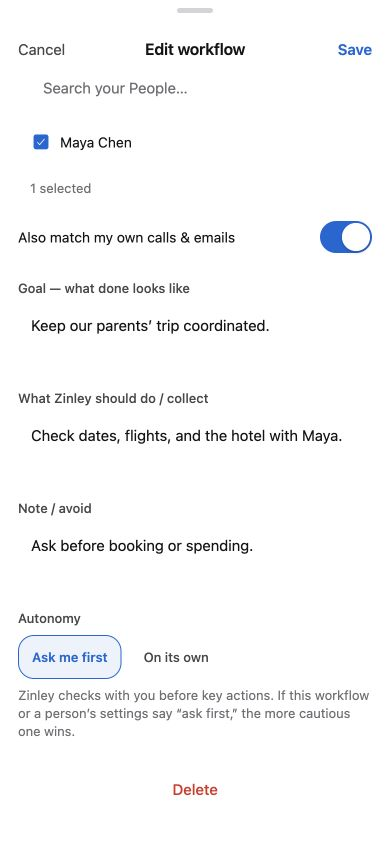
And it does not stop at your own devices. When your intelligence can talk to someone else's intelligence, entirely new things become possible. You want to plan dinner with a friend. Your agent knows your schedule, your dietary preferences, your side of town. Their agent knows theirs. The two talk, find a restaurant that works for both, pick a time neither of you would have thought to suggest, and make the reservation. All you did was say yes.

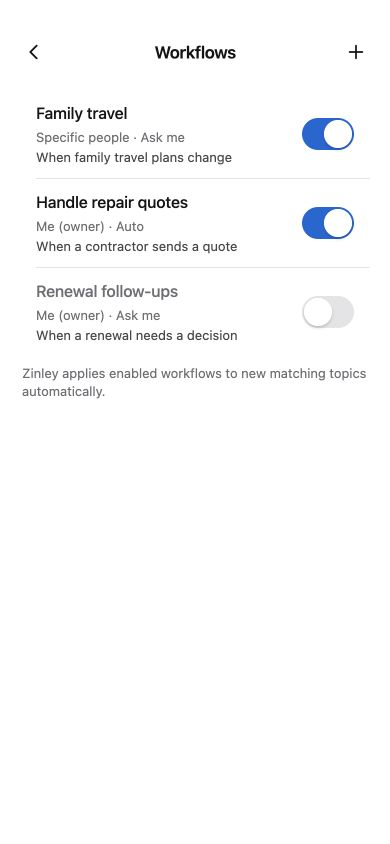
A family where every member's agent coordinates on groceries, pickups, and schedules, without anyone managing a shared calendar. A team where each person's agent handles their piece of a project, passing context between them, so the work moves forward even when the people are not in the same room. A doctor whose agent talks to your agent before the appointment, so the conversation starts where it should instead of with fifteen minutes of paperwork.

First your devices move together for you. Then they move together with the people around you. Every new connection makes the whole network more capable.

Hard Problems

Interconnected Agentic Systems

The problems worth solving are rarely the ones people talk about. Making a single agent smarter is engineering. Making a thousand agents act as one, with no central authority, where each agent sees only a fragment of the whole, that is a fundamentally different class of problem. That is what we work on.

We call it the interconnected agentic system: a distributed mesh of specialized agents that synchronize state, coordinate decisions, and act coherently across devices, environments, and domains, without any single node holding the complete picture. The problems underneath are among the hardest in computer science.

Distributed state synchronization without a central authority. When there is no master clock, no single source of truth, and agents join and leave the network unpredictably, how do they reach consensus? Classical distributed consensus assumes full observability. We operate under partial observability, where each agent perceives only its local environment, and must still converge on a shared understanding of the world.

Multi-agent coordination under incomplete views. Your phone agent knows your calendar. Your car agent knows road conditions. Your home agent knows who is inside. None of them see the full state. Yet they must coordinate actions that span all three, in real time, without contradiction. This is not message passing. It is decentralized decision-making under uncertainty, where the cost of incoherence is felt by a real person.

Emergent behavior guarantees. When many agents interact, collective behaviors emerge that no single agent was programmed to produce. Some emergent behaviors are useful. Others are pathological. How do you prove the system will not converge to degenerate states? How do you guarantee that the emergent whole remains aligned with the person it serves? This sits at the boundary of dynamical systems theory and formal verification, and most of the field has not seriously engaged with it.

Information flow optimization across a dynamic mesh. Agents have different capabilities, different bandwidths, different latencies. A wearable sensor can stream heart rate but not run a large model. A laptop can reason deeply but cannot see your living room. The mesh is constantly changing. Optimizing what information flows where, when, and at what fidelity, across a heterogeneous and shifting topology, is an information-theoretic problem that scales with every new device and every new connection.

These problems sit at the intersection of distributed systems theory, game theory, information theory, and dynamical systems. Solving any one of them is a research contribution. Solving them together, in a system that actually serves people, is the work of a generation.

Scale

From Personal to Civilization-Scale

The principles that let your kitchen light respond gently at 11pm are the same principles that let a fleet of autonomous systems coordinate without a command center. The math does not change. The stakes do.

At the personal level, interconnected agents manage your day. At the enterprise level, they coordinate teams, supply chains, and operations across continents. At the infrastructure level, they manage power grids, transportation networks, and communication systems that millions of people depend on without thinking about.

At the defense level, the same distributed coordination, the same consensus under partial observability, the same emergent behavior guarantees, become the difference between coherent response and catastrophic failure. Autonomous systems that must act together without a central authority. Sensor networks that must fuse incomplete views into shared situational awareness. Swarms that must adapt when communication is degraded and adversaries are actively disrupting coordination. Every hard problem we described is a hard problem in the next generation of defense.

This is not a consumer technology that happens to have defense applications. And it is not a defense technology dressed up for consumers. It is a foundational capability. Distributed state synchronization, multi-agent coordination under uncertainty, emergent behavior guarantees, information flow optimization across dynamic meshes: these are the primitives of the next era. Whoever solves them shapes how intelligence moves through the world, at every scale, in every domain.

The interconnected agentic system is not a product category. It is the infrastructure of the next century: personal, industrial, defensive, civilizational. The technology that coordinates your morning will coordinate the response to the next crisis. That is why this matters.

Inspiration

Why Doraemon

We reference Doraemon because he captures something we have not found a better word for. Doraemon lives alongside Nobita. He understands Nobita's fears and ambitions. He shows up not just when asked but when needed. He gets it wrong sometimes and learns. He carries genuine care across time. He does not optimize Nobita's schedule. He helps Nobita grow up.

Doraemon's magic was never any single gadget. It was the judgment of which gadget to pull out, and when, and why. That is what makes intelligence personal.

Building

What We Are Building

At Zinley, we do foundation research and translate it into products that genuinely serve people, this generation and the next. We believe in doing things the right way, even when it takes longer.

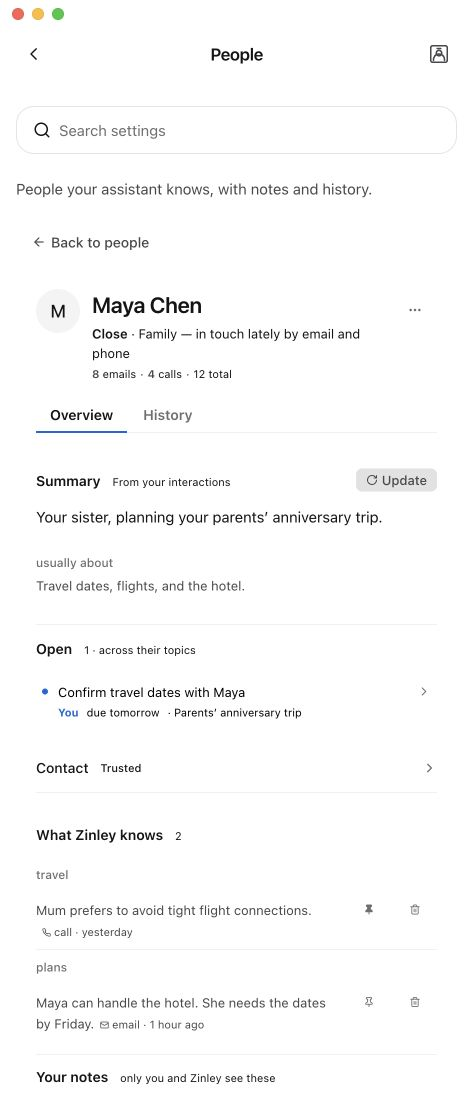
Our architecture is built around interconnection from the ground up. Specialized agents live on each of your devices, perceive their local environment natively, and coordinate through an encrypted layer. Context streams in real time. One unified presence that grows with every interaction, every surface, every connection.

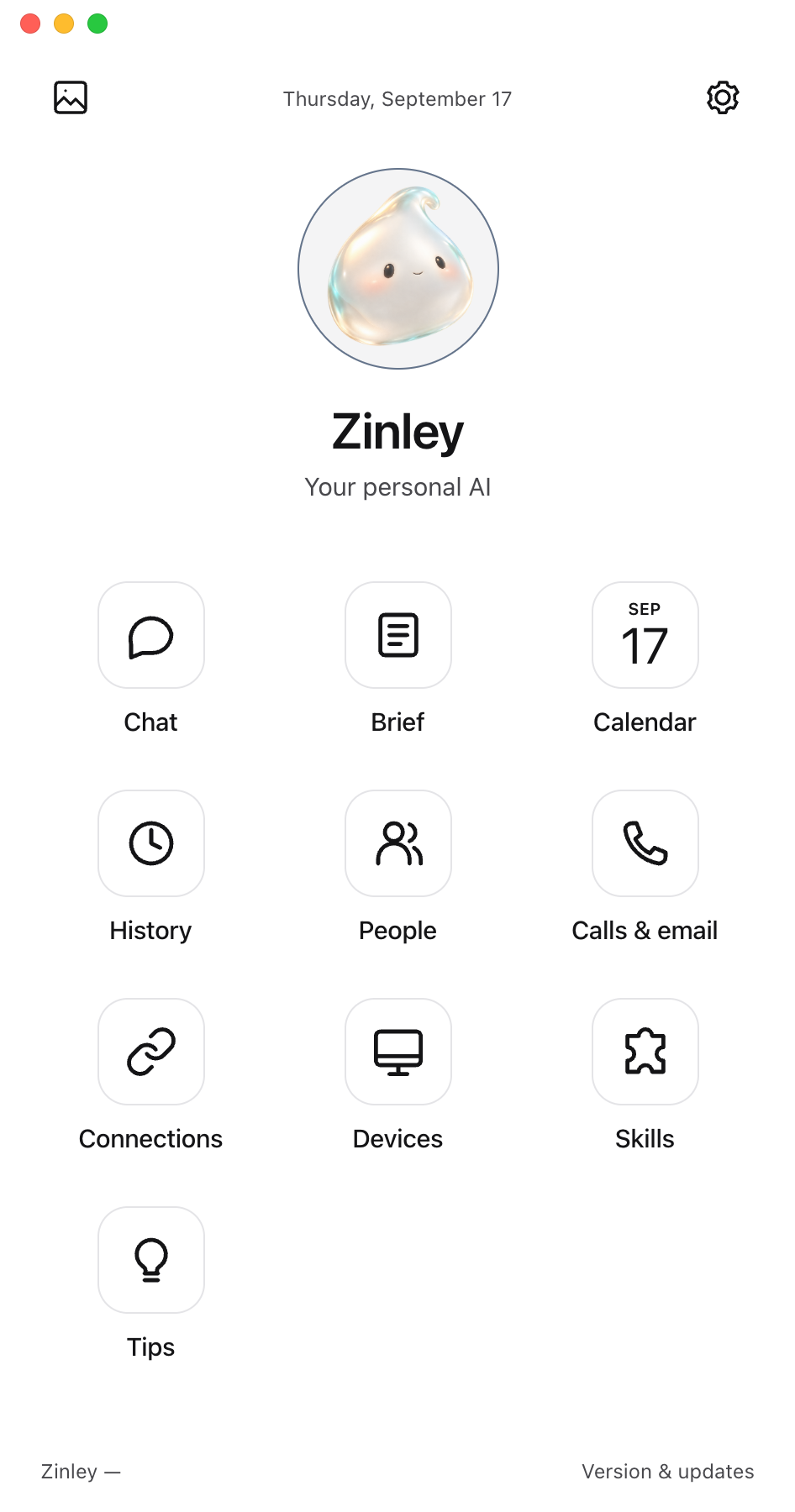
We are still building. Check out Orion, our Doraemon in the making.

Team

Our Team

We are grateful to have a team whose experiences span both research and engineering at scale.

Google Apple Meta Amazon Netflix PayPal J.P. Morgan Stanford Oxford Cambridge Georgia Tech UCSD UCL Google DeepMind Microsoft Research Published at ICML & NeurIPS Billions of users served 700B+ events/day Open-source AI frameworks Founded & acquired startups

These experiences taught us how hard it is to build systems that truly work for people. The problem we are working on is bigger than any of us, and we are grateful to be working on it together.

Let's Talk

If this resonates with you, we would love to hear from you.

[email protected]